Note
Go to the end to download the full example code.
A demo of CRFE on German Credit Data#
Recursive feature elimination with CRFE on the German
credit dataset (1,000 applicants, 20 features). The one-hot columns of each
categorical feature are kept or removed together, and two numerical features with
a Pearson correlation of at least 0.5 cannot both be selected.
The dataset is public and is available on OpenML (ID 31). Please cite it as: Dr. Hans Hofmann, Statlog (German Credit Data), UCI Machine Learning Repository, 1994.
Load the data#
The target is good or bad credit risk. It is encoded as 1 for good.
from sklearn.datasets import fetch_openml

X, y = fetch_openml(data_id=31, as_frame=True, return_X_y=True, parser="auto")
y = (y == "good").astype(int)

categorical_features = X.select_dtypes("category").columns.tolist()
numerical_features = X.select_dtypes("number").columns.tolist()

print(
    f"{len(categorical_features)} categorical and {len(numerical_features)} numerical features"
)
13 categorical and 7 numerical features
One-hot encoding#
Each categorical feature is one-hot encoded. The encoded columns keep the original feature name as a prefix, so they can be grouped by name.
import pandas as pd
from sklearn.compose import ColumnTransformer, make_column_selector
from sklearn.preprocessing import OneHotEncoder

preprocessor = ColumnTransformer(
    transformers=[
        ("cat", OneHotEncoder(), make_column_selector(dtype_include="category"))
    ],
    remainder="passthrough",
    verbose_feature_names_out=False,
)
X_transformed = pd.DataFrame(
    data=preprocessor.fit_transform(X),
    columns=preprocessor.get_feature_names_out(),
)

print(X_transformed.shape)
(1000, 61)
Constraints#
An AllOrNoneConstraint on the
encoded columns of each categorical feature keeps the whole feature or removes
it. A MaxCorrelationConstraint on
the numerical features limits their pairwise correlation.
from tagarnina.optimization.constraints import (
    AllOrNoneConstraint,
    Constraints,
    MaxCorrelationConstraint,
)

all_or_none_constraints = [
    AllOrNoneConstraint(
        features=[c for c in X_transformed.columns if c.startswith(f"{feature}_")]
    )
    for feature in categorical_features
]

max_corr_constraint = MaxCorrelationConstraint(
    features=numerical_features,
    max_corr=0.5,
    method="pearson",
)

constraints = Constraints(
    constraints=[*all_or_none_constraints, max_corr_constraint],
)
Feature elimination#
CRFE refits the estimator at each step and removes
features until 20 remain. The constraints decide which features can be removed.
from sklearn.ensemble import RandomForestClassifier

from tagarnina.crfe import CRFE

estimator = RandomForestClassifier(max_depth=10, min_samples_leaf=0.2, random_state=0)

crfe = CRFE(
    estimator=estimator,
    constraints=constraints,
    step=0.1,
    n_features_to_select=20,
    scoring="roc_auc",
)
crfe.fit(X_transformed, y)

selected_features = crfe.get_feature_names_out()
print(selected_features)
['other_payment_plans_bank' 'other_payment_plans_none'
 'other_payment_plans_stores' 'housing_for free' 'housing_own'
 'housing_rent' 'job_high qualif/self emp/mgmt' 'job_skilled'
 'job_unemp/unskilled non res' 'job_unskilled resident'
 'own_telephone_none' 'own_telephone_yes' 'foreign_worker_no'
 'foreign_worker_yes' 'duration' 'installment_commitment'
 'residence_since' 'age' 'existing_credits' 'num_dependents']
Each categorical feature is either fully selected or fully removed:
for feature in categorical_features:
    columns = [c for c in X_transformed.columns if c.startswith(f"{feature}_")]
    n_selected = sum(c in selected_features for c in columns)
    print(f"{feature}: {n_selected} of {len(columns)} columns selected")
checking_status: 0 of 4 columns selected
credit_history: 0 of 5 columns selected
purpose: 0 of 10 columns selected
savings_status: 0 of 5 columns selected
employment: 0 of 5 columns selected
personal_status: 0 of 4 columns selected
other_parties: 0 of 3 columns selected
property_magnitude: 0 of 4 columns selected
other_payment_plans: 3 of 3 columns selected
housing: 3 of 3 columns selected
job: 4 of 4 columns selected
own_telephone: 2 of 2 columns selected
foreign_worker: 2 of 2 columns selected
The correlation constraint is checked the same way. The check lists the pairs of selected numerical features with a correlation of at least 0.5, which should be none.
from itertools import combinations

selected_numerical = [f for f in numerical_features if f in selected_features]
corr = X_transformed[selected_numerical].corr(method="pearson")
pairs = [(a, b, corr.loc[a, b]) for a, b in combinations(selected_numerical, 2)]
violations = [(a, b, round(r, 3)) for a, b, r in pairs if r >= 0.5]

print(f"{len(selected_numerical)} numerical features selected, {len(pairs)} pairs")
print(f"Pairs with correlation >= 0.5: {violations}")
6 numerical features selected, 15 pairs
Pairs with correlation >= 0.5: []
History#
history_ has one entry per fitted support, from
all features down to the 20 selected ones. The fields shown below are:
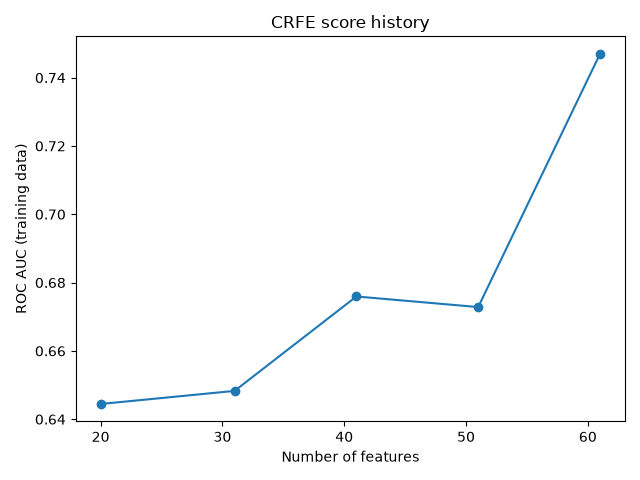
n_features: number of features in the support.removed: number of features removed from the support in the next step.score: ROC AUC on the training data.importance_gap: importance lost because of the constraints. It compares the importance kept with the constraints to the importance that standard RFE would keep with the same number of features. It is 0 without constraints.n_infeasible_probes: candidate removals rejected by the constraints.
The last row has no next step, so removed and n_infeasible_probes are
NaN.
import pandas as pd

history = pd.DataFrame(
    {
        key: crfe.history_[key]
        for key in [
            "n_features",
            "removed",
            "score",
            "importance_gap",
            "n_infeasible_probes",
        ]
    }
)
print(history.round(3).to_string(index=False))
n_features  removed  score  importance_gap  n_infeasible_probes
        61     10.0  0.747           0.250                  0.0
        51     10.0  0.673           0.000                  0.0
        41     10.0  0.676           0.289                  0.0
        31     11.0  0.648           0.122                  0.0
        20      NaN  0.644             NaN                  NaN
The score history is plotted below. The score is computed on the training data, so it is optimistic and tends to increase with the number of features.
import matplotlib.pyplot as plt

fig, ax = plt.subplots()
ax.plot(crfe.history_["n_features"], crfe.history_["score"], marker="o")
ax.set_xlabel("Number of features")
ax.set_ylabel("ROC AUC (training data)")
ax.set_title("CRFE score history")
fig.tight_layout()
Total running time of the script: (0 minutes 2.756 seconds)