Note
Go to the end to download the full example code.
Custom importance getter with SHAP values in CRFE#
HistGradientBoostingClassifier does not expose coef_
or feature_importances_, so the default importance_getter="auto" of
CRFE cannot rank its features. This example passes a
callable instead. The callable returns the mean absolute SHAP value of each
feature, which is a global importance that works for any tree model that SHAP
can explain.
The dataset is the German credit dataset from the basic example, with the same one-hot encoding and the same all-or-none constraints on the categorical features.
The dataset is public and is available on OpenML (ID 31). Please cite it as: Dr. Hans Hofmann, Statlog (German Credit Data), UCI Machine Learning Repository, 1994.
Load the data and build the constraints#
import warnings

import pandas as pd
from sklearn.compose import ColumnTransformer, make_column_selector
from sklearn.datasets import fetch_openml
from sklearn.preprocessing import OneHotEncoder

from tagarnina.optimization.constraints import AllOrNoneConstraint, Constraints

warnings.filterwarnings("ignore")

X, y = fetch_openml(data_id=31, as_frame=True, return_X_y=True, parser="auto")
y = (y == "good").astype(int)
categorical_features = X.select_dtypes("category").columns.tolist()

preprocessor = ColumnTransformer(
    transformers=[
        ("cat", OneHotEncoder(), make_column_selector(dtype_include="category"))
    ],
    remainder="passthrough",
    verbose_feature_names_out=False,
)
X_transformed = pd.DataFrame(
    data=preprocessor.fit_transform(X),
    columns=preprocessor.get_feature_names_out(),
)

constraints = Constraints(
    constraints=[
        AllOrNoneConstraint(
            features=[c for c in X_transformed.columns if c.startswith(f"{feature}_")]
        )
        for feature in categorical_features
    ],
)
The default importance getter fails#
With importance_getter="auto" the first fit raises an error, because the
estimator exposes neither coef_ nor feature_importances_.
from sklearn.ensemble import HistGradientBoostingClassifier

from tagarnina.crfe import CRFE

estimator = HistGradientBoostingClassifier(random_state=0)

try:
    CRFE(
        estimator=estimator,
        constraints=constraints,
        step=0.1,
        n_features_to_select=20,
        scoring="roc_auc",
    ).fit(X_transformed, y)
except ValueError as error:
    print(error)
CRFE: importance_getter='auto' requires the estimator to expose coef_ or feature_importances_.
SHAP importance getter#
The callable receives the fitted estimator and the current features X.
It explains the model with shap.TreeExplainer and returns the mean
absolute SHAP value of each feature. CRFE calls it at every elimination step, so
the importances always refer to the features still in the model.
import numpy as np
import shap


def shap_importances(*, estimator, X):
    explainer = shap.TreeExplainer(estimator)
    shap_values = explainer.shap_values(X)
    return np.abs(shap_values).mean(axis=0)
Feature elimination#
The run is the same as in the basic example, with the callable as
importance_getter.
crfe = CRFE(
    estimator=estimator,
    importance_getter=shap_importances,
    constraints=constraints,
    step=0.1,
    n_features_to_select=20,
    scoring="roc_auc",
)
crfe.fit(X_transformed, y)

selected_features = crfe.get_feature_names_out()
print(f"Selected {len(selected_features)} features")
print(crfe.summary_["termination"])
Selected 20 features
reached the target number of features
Explaining the final model#
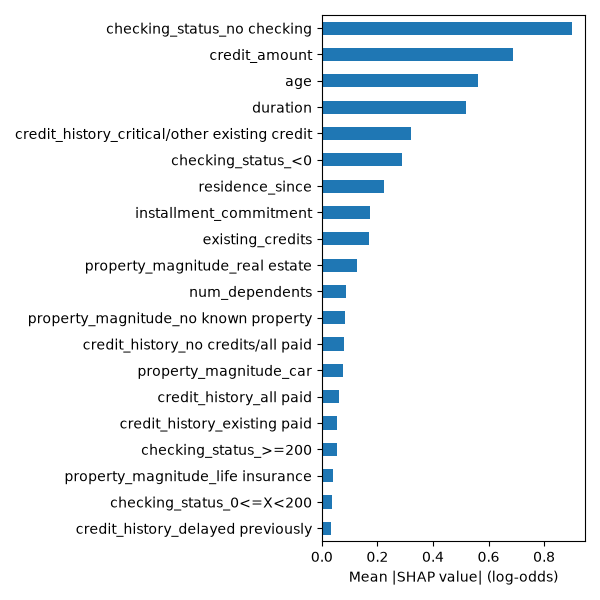
estimator_ is fitted on the selected features. The
bar plot shows their mean absolute SHAP values on the training data.
import matplotlib.pyplot as plt

X_selected = X_transformed[selected_features]
shap_values = shap.TreeExplainer(crfe.estimator_).shap_values(X_selected)

fig, ax = plt.subplots(figsize=(6, 6))
mean_abs = pd.Series(np.abs(shap_values).mean(axis=0), index=selected_features)
mean_abs.sort_values().plot.barh(ax=ax)
ax.set_xlabel("Mean |SHAP value| (log-odds)")
fig.tight_layout()
Total running time of the script: (0 minutes 6.713 seconds)